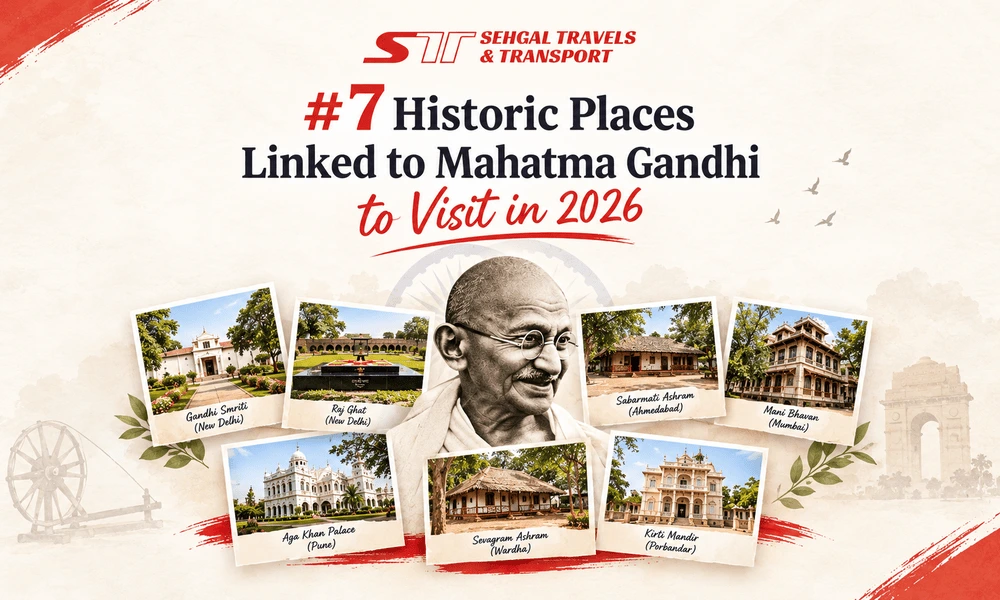
7 Historic Places Linked to Mahatma Gandhi to Visit in 2026
India’s history is closely connected with the life and work of Mahatma Gandhi. From peaceful ashrams and historic homes to memorials and museums, several places across the country preserve important chapters of his journey. Visiting these locations offers more than ordinary sightseeing because each place has its own story connected with India’s freedom movement.
For families, students, history enthusiasts, and group travellers, 2026 can be a good time to explore these destinations as part of a heritage journey. Some places can be visited during a Delhi city tour, while others can become part of longer road trips through Gujarat and Maharashtra.
Here are seven historic places associated with Mahatma Gandhi that you can consider adding to your travel plans in 2026.
1. Gandhi Smriti, New Delhi
Gandhi Smriti is one of the most significant Gandhi-related places in Delhi. Located at the former Birla House on Tees January Marg, it is associated with the final days of Gandhi’s life.
Gandhi stayed at this residence from September 1947 until January 30, 1948. Today, the site has been preserved as a memorial and museum. Visitors can see the rooms associated with his stay, photographs, exhibitions, and the area connected with his final prayer meeting.
One of the most meaningful parts of the visit is the pathway leading toward the prayer ground. The simple surroundings encourage visitors to pause and understand the historical importance of the location.
For families and school groups, Gandhi Smriti can be an informative starting point for exploring Delhi’s freedom movement history with tempo traveller on rent Delhi.
2. Raj Ghat, New Delhi
Raj Ghat is another important Gandhi landmark in Delhi. Situated beside the Yamuna, the memorial marks the place associated with Gandhi’s last rites following his assassination in January 1948.
The memorial itself is simple, consisting of a black marble platform surrounded by gardens. An eternal flame is kept at the site, while the surrounding greenery gives the area a quiet atmosphere.
A visit to Raj Ghat can easily be combined with other nearby historical attractions. Gandhi Darshan, which presents information about Gandhi’s life and the freedom movement, can also be included in a broader heritage itinerary.
Rather than treating Raj Ghat as just another sightseeing stop, visitors can spend some time observing the memorial and learning about the historical events connected with it.
3. Sabarmati Ashram, Ahmedabad
Sabarmati Ashram in Ahmedabad is one of the places most closely associated with Gandhi’s life and activities. Located on the banks of the Sabarmati River, the ashram became an important centre for his work.
The peaceful surroundings provide a different experience from the busy streets of Ahmedabad. Simple buildings, open spaces, photographs, documents, and displays help visitors understand the lifestyle and activities associated with the ashram.
Hridaya Kunj is particularly significant. It was Gandhi’s residence at the ashram and provides an insight into his simple way of living.
Visitors interested in India’s freedom movement can also use Ahmedabad as the starting point for exploring other historical and cultural attractions in Gujarat.
A visit here is best enjoyed without rushing. Spending time with the displays can help visitors understand the people, campaigns, and ideas connected with the ashram.
4. Mani Bhavan, Mumbai
Mumbai has its own important connection with Gandhi through Mani Bhavan. This historic building served as an important centre for his activities in Mumbai between 1917 and 1934.
Today, Mani Bhavan houses a museum containing photographs, books, documents, and other material connected with Gandhi. The building also recreates aspects of the environment in which he worked and lived during his years in Mumbai.
One interesting feature is the collection of photographs showing different stages of Gandhi’s public life. Visitors can also learn about various movements and campaigns associated with his activities during this period.
Mani Bhavan is particularly suitable for travellers who want to explore the personal and working side of Gandhi’s life rather than only visiting large public monuments.
Its location in a busy part of Mumbai also creates an interesting contrast between the city’s modern character and the history preserved inside the building.
5. Aga Khan Palace, Pune
The Aga Khan Palace is an important historical landmark in Pune with a strong connection to the freedom movement. Built in the nineteenth century, the palace later became associated with the Quit India Movement.
During 1942, Gandhi, Kasturba Gandhi, Mahadev Desai, and other leaders were detained at the palace. Kasturba Gandhi and Mahadev Desai died during their confinement there, and memorials within the grounds remember them.
The palace combines historical importance with impressive architecture. Its spacious grounds and large structure make it different from the simple ashrams associated with Gandhi.
Inside, visitors can see photographs and objects connected with Gandhi and the freedom movement. The museum provides useful context for understanding the events that took place during the Quit India period.
For anyone planning a Maharashtra heritage trip, Aga Khan Palace can be an important stop alongside other historical attractions in Pune, while Force Urbania Hire in Delhi can be considered for planning the journey from Delhi.
6. Sevagram Ashram, Wardha
Sevagram Ashram near Wardha offers a quieter experience for visitors interested in Gandhi’s later work and lifestyle.
Gandhi established Sevagram in 1936. The ashram includes several places connected with Gandhi and his associates, including Bapu Kuti, Ba Kuti, Adi Nivas, and the prayer ground.
The simplicity of the surroundings is one of the most noticeable features. Instead of grand buildings, visitors encounter modest cottages, open spaces, pathways, and objects connected with everyday life at the ashram.
Bapu Kuti is particularly important because it was Gandhi’s residence at Sevagram. Seeing the simple environment in which he lived can help visitors understand the practical side of his philosophy.
Sevagram is better suited to travellers who have enough time for a relaxed visit. It can be included in a longer Maharashtra itinerary rather than treated as a quick sightseeing stop.
7. Kirti Mandir, Porbandar
To explore the beginning of Gandhi’s life, travellers can visit Kirti Mandir in Porbandar, Gujarat.
Gandhi was born in Porbandar on October 2, 1869. His ancestral home has been preserved as part of the memorial complex associated with Kirti Mandir.
The site gives visitors an opportunity to learn about his early years and family background before his later involvement in public life and the freedom movement.
Kirti Mandir is different from places such as Raj Ghat or Gandhi Smriti because it focuses on the beginning of his life rather than its final chapter.
A trip to Porbandar can also be combined with other destinations in Gujarat, making it suitable for travellers planning a longer heritage or cultural road trip.
Planning a Gandhi Heritage Trip in 2026
Visiting all seven destinations in one journey may not be practical because they are spread across different states. Planning the region by region can make the experience easier and more enjoyable.
A Delhi itinerary can cover Gandhi Smriti and Raj Ghat together. Gujarat can be planned around Sabarmati Ashram and Kirti Mandir, while a Maharashtra journey can include Mani Bhavan, Aga Khan Palace, and Sevagram.
For a larger family or group, you may also choose to rent a bus for group travel in Delhi when planning a long-distance heritage tour. Keeping everyone together can make group travel more convenient.
The most important part is to avoid creating an overly packed schedule. Historic places are best experienced when visitors have enough time to explore the exhibitions, read the information available, and understand the story behind each location.
Tips for Visiting Gandhi-Related Historic Places
Check Timings Before You Travel
Museum and memorial timings can change, particularly around public holidays or special events. Checking current visitor information before leaving can help avoid inconvenience.
Keep Enough Time for Each Location
These places contain more than buildings and memorials. Photographs, documents, personal belongings, and exhibitions often provide the most useful historical context.
Plan Your Route Carefully
Since the seven destinations are spread across different regions, divide the journey into smaller circuits instead of attempting to cover everything in a short trip.
Choose Transportation According to Group Size
Families and groups should consider seating, luggage space, road distance, and rest stops when arranging transportation.
Make the Trip Educational
Parents and teachers can encourage children to note down interesting facts from each destination. This can make a sightseeing trip more engaging and memorable.
FAQs
Q: Which Gandhi-related places can I visit in Delhi?
A: Gandhi Smriti and Raj Ghat are two major places associated with Gandhi in Delhi. They can be included together in a city heritage itinerary.
Q: Where was Mahatma Gandhi born?
A: Mahatma Gandhi was born in Porbandar, Gujarat, on October 2, 1869. His birthplace is preserved as part of the Kirti Mandir complex.
Q: Which place in Mumbai is connected with Gandhi?
A: Mani Bhavan is one of the most important Gandhi-related sites in Mumbai. Gandhi used the building as a base for his activities between 1917 and 1934.
Q: Why is Aga Khan Palace important?
A: Aga Khan Palace is associated with the Quit India period of the freedom movement. Gandhi, Kasturba Gandhi, Mahadev Desai, and others were detained there in 1942.
Q: Where is Sevagram Ashram located?
A: Sevagram Ashram is located near Wardha in Maharashtra. Gandhi established the ashram in 1936.
Final Thoughts
Exploring places connected with Mahatma Gandhi can turn a normal holiday into a meaningful heritage journey. Each destination tells a different part of the story from his birthplace in Porbandar and his years of work in Ahmedabad and Mumbai to the important events remembered in Pune and Delhi.
For travellers in 2026, these locations can be explored individually or combined into regional road trips. Families, students, friends, and larger groups can plan their journeys according to available time and choose transportation that suits their group size. Sehgal Travels can be considered when arranging group transportation for such heritage journeys.
A thoughtfully planned Gandhi heritage tour is not only about visiting monuments. It is an opportunity to see historic surroundings, learn about important events, and experience different parts of India along the way.

Recent Posts

7 Historic Places Linked to Mahatma Gandhi to Visit in 2026

Innova on Rent in Delhi: A Practical Guide for Comfortable Travel